Property Types
What is a cross lease? Pros and cons
Learn what a cross-lease property is, and what you need to know before buying or selling one – to ensure you don’t trip on commonly found issues.
Property Types
5 min read

Author: Ed McKnight
Resident Economist, with a GradDipEcon and over five years at Opes Partners, is a trusted contributor to NZ Property Investor, Informed Investor, Stuff, Business Desk, and OneRoof.
Reviewed by: Andrew Nicol
Managing Director, 20+ Years' Experience Investing In Property, Author & Host
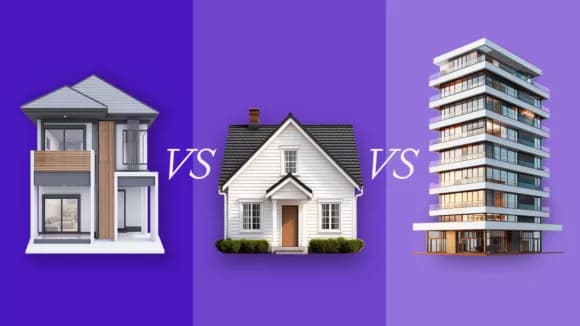
Townhouses usually grow in value slightly slower than houses, but only by a small margin. While apartments tend to grow in value much more slowly.
At Opes Partners, we recommend townhouses to property investors. We also help Kiwis invest in standalone houses and apartments.
That does mean I’ve got an incentive to be biased and tell you that townhouses go up in value the fastest. I’m not going to do that.
That’s why we got data from the Real Estate Institute of New Zealand (REINZ) to compare how houses, townhouses and apartments have performed over time.
The goal here isn’t to push one type of property over another. It’s to show you what the data says, so you can decide which investment is right for you.
| Property type | How fast does it go up in value? | Investor takeaway |
| Standalone houses | Fastest | Strong capital growth, but usually more expensive |
| Townhouses | Slightly slower than houses | Similar growth, often at a more affordable price |
| Apartments | Slowest | Higher rental yields, but weaker capital growth |
Standalone houses usually grow fastest, townhouses come close while often being more affordable, and apartments tend to lag on long-term capital growth.
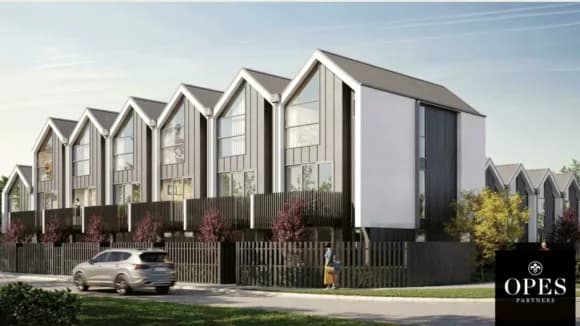
When Kiwis talk about townhouses, they are often referring to terraced housing. That’s a row of properties, attached by at least one wall.
Townhouses often share driveways or common areas. And there may be a Residents’ Association or body corporate to manage those areas.
Typically, townhouses are spread over 1 to 3 storeys and have a private patio or garden.
Townhouse developments can range in size from small 3-unit clusters ... all the way up to full neighbourhoods with 100+ units.
Standalone houses, by contrast, give buyers full control over both the home and the land. There are no shared walls, body corporate rules, or shared maintenance levies.
The trade-off is that all repairs, upkeep, upgrades, and decisions sit entirely with the owner.
For investors, the "townhouse vs houses" decision often comes down to:
| Townhouse | Standalone houses |
More affordable and often easier for first-home buyers to purchase Can make it easier to buy closer to city centres and key amenities Lower maintenance, with some shared areas managed collectively Modern and compact | Usually more expensive upfront Central locations often come at a higher price Full responsibility for all maintenance and upkeep More land and privacy |
When it comes to house price increases, houses usually come out on top. But the real question is: by how much?
Let’s take a look at the data for our three larger cities:
In Auckland, there is some difference between houses and townhouses, but the difference isn’t that much.
The dark blue line shows the average annual capital growth of townhouses (averaged over the prior 7 years). The light blue line shows the same data for houses.
Based on REINZ median sales data, Auckland houses outperformed townhouses 90% of the time, but only by an average margin of 0.66% a year.
That means if houses received a capital growth rate of 7%, townhouses grew by 6.3% in that given year.
In Wellington City it’s a slightly different story. Houses only beat townhouses 51% of the time. On average, houses only beat townhouses by 0.07% per year.
This means that if a house increased by 5% in a year, the equivalent townhouse increased 4.9%.
Christchurch is similar to Auckland.
Houses increased in value faster 75% of the time, but only by a 0.7% margin.
A note on the data: This set used the median sales data. This is a lesser-quality than the apartment data we discuss below. But it is the best we have.
It’s still good. But it means we need to look for big slam-dunk trends to have confidence in the conclusions. If we see an undeniable trend, that’s when we can have confidence in the findings.
Apartments tend to go up in value more slowly than houses and townhouses.
Across the dataset, houses and townhouses outperformed apartments 92% of the time and grew 3.03% faster a year in Auckland City.
In Wellington, it’s the same. Apartments don’t increase in value as quickly, despite the high number of apartments in the city.
Sure, in the very early days of the 2000s, the growth rates for apartments were higher than for houses or townhouses.
But that trend didn’t last.
The value of townhouses and houses increased faster 86% of the time. On average they increase in value 2.41% faster per year.
Let’s dig into the pros and cons of houses, townhouses and apartments when it comes to investments.
| Property type | Pros for investors | Cons for investors |
| Houses | Often strongest for long-term capital growth and familiar to most buyers | More expensive to buy and often located further from city centres |
| Townhouses | More affordable, often closer to the inner city, still have strong capital growth, and can achieve strong rental yields | Usually less land and smaller outdoor areas |
| Apartments | Often the cheapest option to buy and can deliver higher rental yields | Usually, slower capital growth compared with houses and townhouses |
All things being equal, standalone houses tend to go up in value the fastest and are also the most familiar.
But they also tend to be further out of the city and are more expensive. That means not every investor can afford one.
Townhouses tend to offer higher rental yields. Because they’re more affordable, you can often buy one that’s closer to the inner city. Tenants love being closer to work.
But they can have smaller gardens and land, which not everyone likes.
Apartments are often the cheapest option. They achieve higher rental yields, but they also go up in value the slowest.
If your goal is capital growth, standalone houses usually come out on top.
But townhouses are not far behind, and they are often more affordable and easier to buy in better locations.
Apartments can work too, especially for yield-focused investors.
But the long-term growth story is usually weaker.
So, the right choice is not just about which property type grows fastest. It’s about which one fits your budget, goals, and risk profile.
Resident Economist, with a GradDipEcon and over five years at Opes Partners, is a trusted contributor to NZ Property Investor, Informed Investor, Stuff, Business Desk, and OneRoof.
Ed, our Resident Economist, is equipped with a GradDipEcon, a GradCertStratMgmt, BMus, and over five years of experience as Opes Partners' economist. His expertise in economics has led him to contribute articles to reputable publications like NZ Property Investor, Informed Investor, OneRoof, Stuff, and Business Desk. You might have also seen him share his insights on television programs such as The Project and Breakfast.
This article is for your general information. It’s not financial advice. See here for details about our Financial Advice Provider Disclosure. So Opes isn’t telling you what to do with your own money.
We’ve made every effort to make sure the information is accurate. But we occasionally get the odd fact wrong. Make sure you do your own research or talk to a financial adviser before making any investment decisions.
You might like to use us or another financial adviser